
The beginning · King Shahryar and Scheherazade
The Brave Storyteller: How Scheherazade Began the Thousand and One Nights
The voice comes from your own device. Nothing is sent anywhere.
Long, long ago, in the days of the Sasanian kings of Persia, there lived a great king called Shahryar. The old book says his kingdom reached as far as the islands of India and China. His younger brother, Shah Zaman, was the king of Samarkand. For twenty years the two brothers ruled fairly, and their people loved them.
One day King Shahryar missed his brother very much. He sent his vizier, his chief helper, with fine horses, rich cloth and a letter. "Please come and visit me," the letter said. "I want to see your face again."
Shah Zaman set off at once. But just before he left, he found out that his queen had been dishonest with him and had broken her promises. His heart filled with sorrow. All the way to his brother's city he grew paler and quieter.
King Shahryar was happy to see his brother, but worried too. "Why are you so pale?" he asked. Shah Zaman would not say. One day, while Shahryar was away hunting, Shah Zaman looked out of a window into the palace garden. He saw that Shahryar's own queen was dishonest too, just like his. "So I am not the only one with this trouble," he thought, and slowly he began to eat and sleep and smile again.
When Shahryar came home, he asked his brother why he looked so well. At last Shah Zaman told him everything. Shahryar did not want to believe it, but he saw it with his own eyes. The two kings were so hurt that they left their palace and wandered the world together. On a lonely shore they even saw a mighty jinni rise out of the sea like a black pillar of smoke. Even he, they learned, had been tricked by someone he trusted.
King Shahryar came home with a hard and bitter heart. "I will never trust anyone again," he said. Then he made a terrible law. Each evening he married a new bride, and each morning he ordered his vizier to take her life. For three long years the city lived in fear. Families ran away with their daughters, and mothers cried in the streets.
The vizier had two daughters. The elder was Scheherazade. The old book says she had gathered a thousand books of history and the stories of kings long gone. She knew poems by heart. She was wise and clever, and kind to everyone. Her younger sister was Dunyazad.
One day Scheherazade saw her father sitting alone, full of worry. "Father, what is wrong?" she asked. He told her everything. Scheherazade was quiet for a moment. Then she said, "Let me marry the king. Either I will live, or I will save the other girls of this city."
Her father was frightened. "Do not put your life in danger!" he cried. To change her mind, he told her a story.
"Once there was a farmer who could understand what animals said," he began. "In his barn lived a Bull and a Donkey. The Bull pulled the heavy plough all day, while the Donkey rested. 'Pretend to be sick,' the Donkey told the Bull. 'Then you can rest too.' The Bull did, and he rested all day. But the farmer had heard every word. So he sent the Donkey to pull the plough instead! That evening the tired Donkey was sorry he had ever given advice. He soon tricked the Bull into going back to work. So you see, my daughter, people who rush into other people's troubles can end up in trouble themselves."
Scheherazade listened kindly. Then she said, "Father, my mind is made up."
So the vizier went to the king. That same evening Scheherazade was taken to the palace. Before she went, she whispered to her sister: "When I am with the king, I will ask him to let you come and say goodbye. Late in the night, ask me to tell you a story. I have a plan."
At the palace, Scheherazade asked the king, "May my little sister come and say goodbye?" The king agreed, and Dunyazad came and sat quietly at the foot of the royal couch. In the middle of the night she spoke up. "Dear sister, if you are not sleepy, please tell us one of your wonderful stories."
"Gladly," said Scheherazade, "if the king allows it."
King Shahryar could not sleep that night. "Tell your story," he said.
And so, on the first of a thousand and one nights, Scheherazade began. Would the king listen? Would she see the morning? Turn the page to Night 1 to find out.
The lesson
Courage can be quiet. Scheherazade did not fight the king with swords. She used what she knew, books and stories and patience, and she put herself in danger to protect others.
Talk about it
- Why do you think Scheherazade wanted to marry the king, even though it was dangerous?
- Her father told her a story to change her mind. Why did it not work?
- What is the cleverest part of Scheherazade's plan?
- Has a story ever changed how you felt about something?
New words
- vizier
- the king's chief adviser and helper
- Sasanian
- the family of kings who ruled Persia (now Iran) from the year 224 to 651
- jinni
- a magical being from old Arabian stories, made of smokeless fire
- plough
- a heavy tool, pulled by animals, that breaks up the soil before planting
Who is in this story
 Scheherazade
 King Shahryar
 Dunyazad
 The Vizier
 Shah Zaman
 Jinn
Where it happens
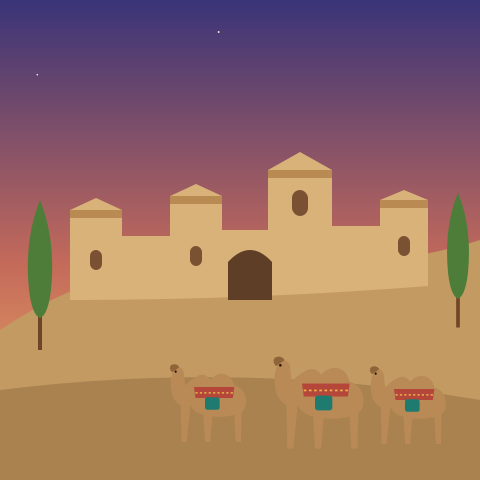 Samarkand
Questions and answers
Who is Scheherazade?
Scheherazade is the storyteller of the Arabian Nights. She is the clever elder daughter of King Shahryar's vizier, and she tells the king a new story every night for a thousand and one nights.
Why did Scheherazade tell the king a story every night?
She wanted to stop the king's cruel law. Each night she stopped at an exciting part, so the king wanted to hear the rest and let her live one more day.
Who is King Shahryar?
Shahryar is the king who listens to Scheherazade's stories. In Burton's notes the name is Persian for "City-friend". After he is hurt by people he trusted, he becomes cruel, until the stories slowly change him.
Is the Scheherazade story suitable for children?
The original opening story has adult themes. This retelling keeps the plot and leaves those parts out, and is written for ages 6 to 12. Our guide for parents explains how we adapt each night.
Where does the story of Scheherazade take place?
The book sets it in the kingdom of the Sasanian kings of Persia. The king's brother, Shah Zaman, rules the city of Samarkand, which is now in Uzbekistan.
From the book
Retold for children from the opening story of "The Book of the Thousand Nights and a Night", translated by Richard F. Burton (1,885), volume 1.
We retell these stories carefully, but mistakes can happen. Report a problem with this page · Content disclaimer